
I have often wondered about the different kinds of books that exist. At a surface level, we divide them neatly into fiction and non-fiction. Non-fiction claims truth. Fiction claims imagination. And yet, there is one genre that has always intrigued me more than any other: the semi-autobiographical work.
The term itself is revealing. Semi. Auto. Biography.
Part self. Part life. Part story.
To me, it feels like the most honest creative license an author can take.
Because the problem with a pure biography—even when written with the best intentions—is that it can never be fully honest. Not really. There are thoughts you cannot write down. Emotions you are socially forbidden from admitting. People who were crucial to your inner life but cannot be named without collateral damage. And who decides what counts as “the main plot” of a life anyway?
Every biography is forced to edit the soul. Trapped to Omit the facts. Its the limitation of the medium.
Fiction, on the other hand, grants total freedom—but often at the cost of depth. When you invent a protagonist from scratch, you are also inventing their emotional gravity. And unless you have lived those arcs—loss, disillusionment, longing, fear, shame—it’s hard to reach the same depths without sounding ornamental or clever rather than true.
A semi-autobiographical work quietly solves this problem.
It uses imagination as camouflage and emotion as truth.


The facts are rearranged. The names are changed. The settings may be fictionalized. But the emotional arc—the thing that actually shapes a human being—is real. Lived. Earned.
This is why semi-autobiographical writing often feels so intimate, even when it is technically “fiction.” The author is not hiding behind imagination; they are using it as a shield to say what could NOT otherwise be said.
This is also where the idea of the death of the author becomes interesting. Once a book enters the world, readers will interpret it in ways the writer never intended. That is inevitable. But in a semi-autobiographical work, even if the reader misreads the facts, the author has still remained honest with themselves. The emotional integrity holds.
That, to me, is the real covenant of this genre.
Why Ernest Hemingway Stands as the Flagship
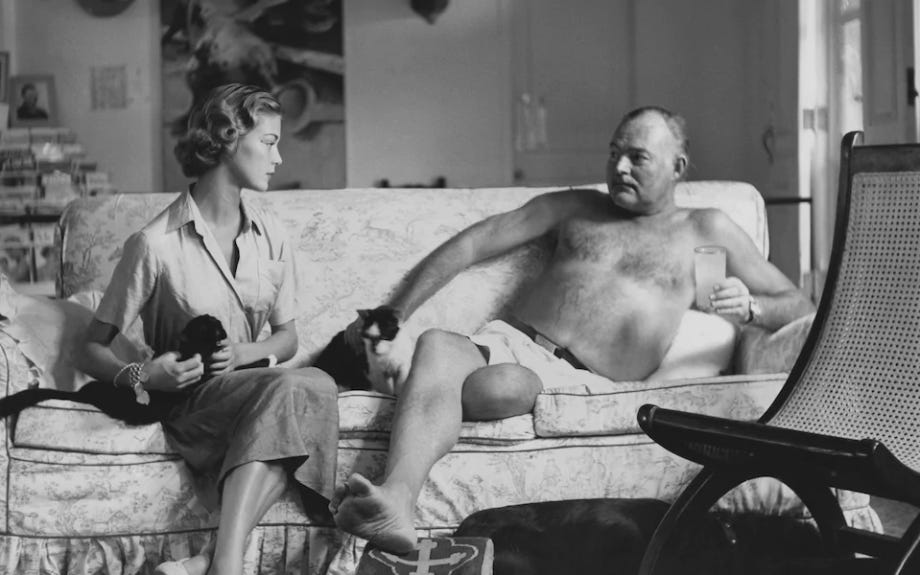
There is a reason I return to Ernest Hemingway when I think about semi-autobiography—not merely as an example, but as a flagship.
Hemingway sits at a rare and uncomfortable intersection of three facts.
First, he was awarded the Nobel Prize in Literature, placing him in an extraordinarily small group of writers whose work is recognized as having altered the literary consciousness of the world.
Second, his life ended by suicide—a fate shared by a small, tragic subset of Nobel laureates, but one that inevitably invites us to look again at the interior weather of the work itself.
And third—and this is where the argument becomes literary rather than sensational— his death was a violent one and not for the faint of the heart. He used his favorite shotgun for the fatal shot, a detail that his wife initially tried to frame as an accident while cleaning the weapon, but suicide was the known cause.
This combination is the flagship usecase of my point here .
Hemingway’s writing consistently bears the marks of contained rage, suppressed despair, and a relentless confrontation with meaninglessness. His prose is famously restrained, even austere. But that restraint is not calm; it is pressure.
Hemingway did not write confessional literature. He did not explain himself. He did not soften his edges for the reader. Instead, he displaced his inner conflict into characters who lived with stoicism in the face of chaos, violence, war, love, and loss. His anger rarely shouted; it clenched its jaw.
Nowhere is this clearer than in A Farewell to Arms. The novel draws directly from Hemingway’s wartime experiences, yet it refuses to become memoir. The protagonist is not “Hemingway on the page.” What is autobiographical is the emotional posture: the detachment, the disillusionment, the sense that courage does not guarantee meaning, and love does not guarantee survival.
The events are fiction.
The emotional cost is not.
This is why Hemingway matters to the genre. His life and death do not “explain” his work in a reductive way, but they do validate something essential: the emotional honesty in his fiction was not performative. It was lived. And it was costly.
In that sense, Hemingway represents the extreme edge of semi-autobiographical writing—not because every writer must suffer as he did, but because his work demonstrates what happens when imagination is used not to escape pain, but to contain it.
Why This Genre Endures
Once you see this, you start noticing how many of the world’s most powerful books take this path—not because it is easier, but because it is braver.
Semi-autobiographical works refuse the safety of pure biography and reject the emptiness of hollow fiction. They choose the uncomfortable middle ground.
They don’t protect themselves by saying, “This is just what happened.”
They don’t distance themselves by saying, “This is just a story.”
They say, instead: This is how it felt.
And that is why these works connect so deeply across time, culture, and language. Because while facts age and contexts change, emotional truth remains legible.
So when we look at the greatest books in the world—those that feel intimate without being confessional, fictional without being hollow—we often find this quiet choice underneath: the choice to tell the truth without telling the whole story literally.
That is not cowardice.
That is craft.
Which is why some of the best books ever written did not hide their emotional crises behind the polite veil of biography. They went all the way in—using imagination to protect honesty rather than dilute it.
They took the semi-autobiographical road.
Just as Hemingway did.
Appendix: Flagship Works of Semi-Autobiographical Literature
(Not exhaustive; representative of the genre’s emotional range)
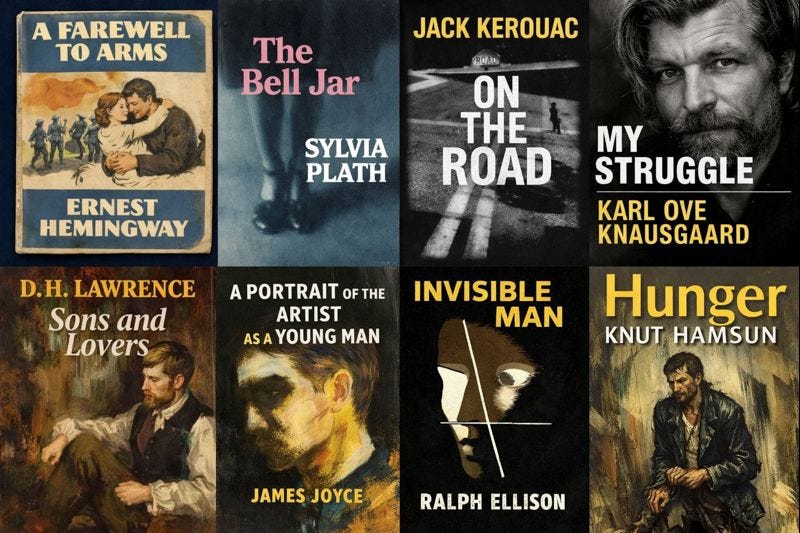
A Farewell to Arms — Ernest Hemingway
The Bell Jar — Sylvia Plath
On the Road — Jack Kerouac
My Struggle — Karl Ove Knausgård
Sons and Lovers — D. H. Lawrence
Portrait of the Artist as a Young Man — James Joyce
Invisible Man — Ralph Ellison
Hunger — Knut Hamsun
Each of these works disguises fact, rearranges memory, and alters circumstance—but none of them fabricate emotional consequence.