

BLUF: Humans and computers both split memory into a fast, volatile workspace and a slower, persistent archive — but while computers optimize correctness and retrieval, humans must optimize meaning and peace: learn to forget well so they can live lighter.
A Map of Human and Computer Memory
A very good friend of mine often jokes that he “has no RAM, only an extremely bloated hard drive.” He can’t hold on to numbers even for a few hours, but he remembers exactly what someone was wearing at a casual meetup from a decade ago. He’s not alone: many of us struggle with memory utilization. Some things slip right through our grasp; others stick whether we want them to or not.
At its core, this is a question of system design. How do we retain things for short-term use versus long-term recall? I sometimes think that drawing, photography, even writing itself, were invented by humans to manage this imbalance.
Computers solved the problem long ago by inventing RAM: a fast, forgettable workspace that frees the processor to focus. Humans don’t have a neat equivalent. We rely on an elastic, messy working memory and a sprawling associative archive. In this essay, I’ll map these two worlds, trace why they exist, and propose a practice I call the daily dump: a ritual to offload clutter, consciously choose what to keep, and practice the art of forgetting.
Part I — The Map
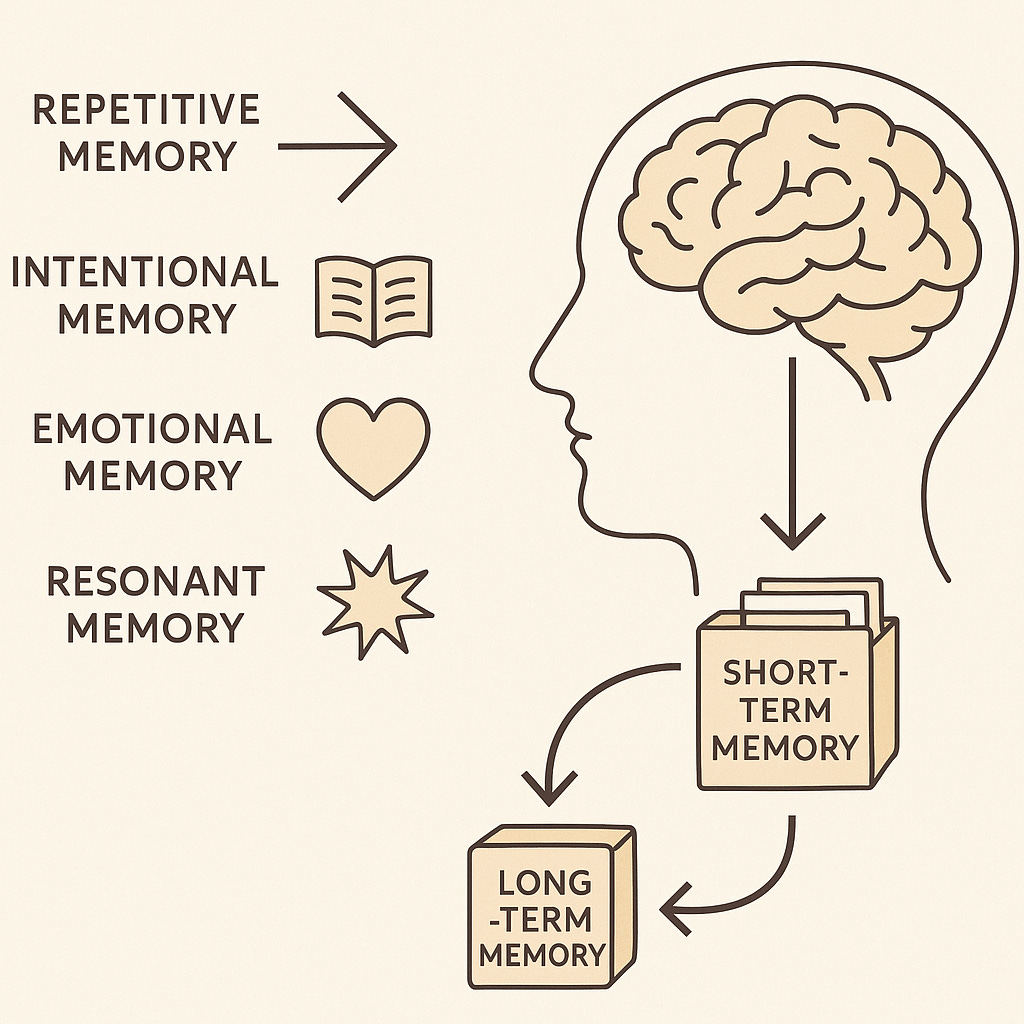
Both humans and computers divide memory into two broad categories:
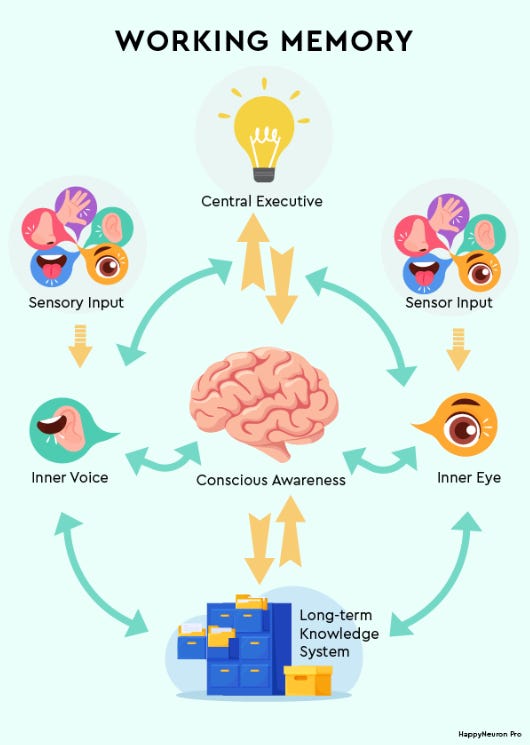
Humans: working/short-term memory vs. long-term memory.
Computers: registers/cache/RAM vs. disk/SSD/archival storage.
The analogy mostly holds:
Volatility: RAM is wiped when power goes off; Human working memory zeroes out on its own unless reinforced.
Fidelity: computers store exact bits; humans store in classes: visual/sound/smell.
Purpose: computer memory supports computation; human memory supports meaning, decision, and feeling.
We also have diverse pathways of learning:
Repetitive memory (muscle memory: typing, cycling).
Intentional memory (studying for a test).
Emotional memory (deeply tied to smells, tastes, hormones, nostalgia).
Resonant memory (those random moments that stick for no clear reason).
Part II — Origins & Mechanics
Why two systems at all? Because speed and permanence rarely coexist.
In computers, the memory hierarchy emerged to balance speed, cost, and persistence: registers → cache → RAM → disk.
In humans, working memory likely evolved for flexible problem-solving (language, tool use), while long-term storage supports identity, and survival.
How scientists have pieced this together, in plain English:
We forget fast at first, then slower later — like snow melting in the sun, most of it drips away early, but a little lingers for a long time.
Long-term memory comes in two broad kinds: “facts and events we can tell stories about” versus “skills we just do without thinking” — like the difference between remembering your wedding date and remembering how to ride a bike.
And the kicker: every time you pull up a memory, you redraw it. Like reopening a file, making edits, and hitting “save” again, your memories are always under revision.
Part III — Memory as a curse, Forgetting is Bliss
If our brains are messy archives, how do we make peace with that? By learning to forget well.
Forget well = curate + offload + ritualize + reconcile.
Curate — Consciously choose what deserves long-term encoding: values, relationships, key learnings.
Offload — Free your working memory by capturing clutter and outsource storage.
Ritualize — Make it daily. Tailor to your style: mind maps for visual learners, free writing for readers, voice notes for auditory thinkers.
Reconcile — Practice intentional forgetting. Let go of unproductive loops (rumination, grudges) by preferred means (journal, meditation, demolition).
Social & ethical note: Don’t outsource moral memory. Tools can help track tasks and facts, but relationships require lived attention. Forgetting well doesn’t mean neglecting; it means lightening the unnecessary load so you can show up more fully.
Closing
As phenomenal as a human brain is, it cannot hold onto infinite information. The act of making this information finite is an undertaking in itself, and, for those of us who suffer from paralysis by analysis, it is paramount to be intentional about it.
Forget well, live lighter.


